
Monrovia Resident Lookup Records
The first choice is the record that fits the question. An assessor parcel can anchor an address but does not list every occupant. The voter screen verifies one registration only after four keys are known. Los Angeles Superior Court supplies party-name and case-number routes. Vital records confirm an event through a controlled copy process. Business and professional sources add affiliation, while local directories and yearbooks are strongest for older household clues.
| Record | What It Confirms | Where | Access |
|---|---|---|---|
| Assessor parcel | Assessed owner, situs, AIN, and parcel facts | Los Angeles County Assessor Portal | Free address or AIN search; no owner-name Internet route |
| Voter status | One registration match and status | LA County Voter Registration Status | Free identity-gated form with four required keys |
| Civil, family, probate index | Party name, case type, filing date, and location | Los Angeles Superior Court CivilIndex | Paid name search; coverage varies by case type |
| Case Access | Case number, status, hearings, docket events, and document links | Los Angeles Superior Court | Free case-number route; web data is not the official record |
| Vital records | Birth, death, marriage, or dissolution event evidence | LA County RR/CC and CDPH-Vital Records | Copy class, eligibility, sworn statement, and fee rules apply |
| Business and professional filings | Entity or license affiliation and public status | California bizfile and DCA Search | Free basic searches; affiliation is not residence proof |
| Directories and yearbooks | Historical address, spouse, occupation, class, or local context | Heritage Room, Museum, and Legacy Project | Appointment, staff retrieval, catalog, or item-specific access |
Start with an address or AIN when property is the known clue. Start with the paid court index when the name and a case question are the clue. Use voter status only when the last name, birthdate, residence house number, and ZIP are already known and the purpose is permitted. For a family event, use an index as a lead and order the correct informational or authorized copy from the custodian. No single Monrovia resident lookup produces a complete household list.
Read a Monrovia Court Result
The Los Angeles Superior Court CivilIndex is the paid name route for unlimited civil, probate, and family cases from 1983-present, limited civil cases from 1991-present, and small claims from 1992-present. The index is updated daily. Search Type separates an individual party from a company. Last Name and First Name are used for an individual, while Company Name is the alternate field. Case Type and Date Range can narrow a result when the name is common.
| Field Label | Type | Required | Options or Format Notes |
|---|---|---|---|
| Search Type | Radio or dropdown | Yes | Individual party name or company name |
| Last Name | Text | Conditional | Individual search; pair with first name and test spelling variants |
| First Name | Text | Conditional | Use initials or alternate forms in a separate paid search |
| Company Name | Text | Conditional | Alternative to person fields |
| Case Type | Selection | Optional or portal-dependent | Civil, Small Claims, Family Law, or Probate categories |
| Date Range | Date selection | Optional or portal-dependent | Narrow the search within available coverage |
| Continue as Guest / Sign In | Buttons | Yes | Guest purchase or registered sliding-fee account |
| Search / New Search / Redo Search | Buttons | Not applicable | Fee authorization precedes results; redo access is time-limited |
Guests pay $4.75 for a name search. Registered accounts use a sliding schedule, starting at $1 for searches 1-10 in a month, then $4.75 for 11-99, $4.50 for 100-999, $4.25 for 1,000-10,000, and $4 for 10,001 or more. A no-match charge still applies. The result can show a litigant name, case type, filing date, filing location, and the count of imaged documents.
The official LASC CivilIndex shows the party-name search path for a Monrovia resident lookup.
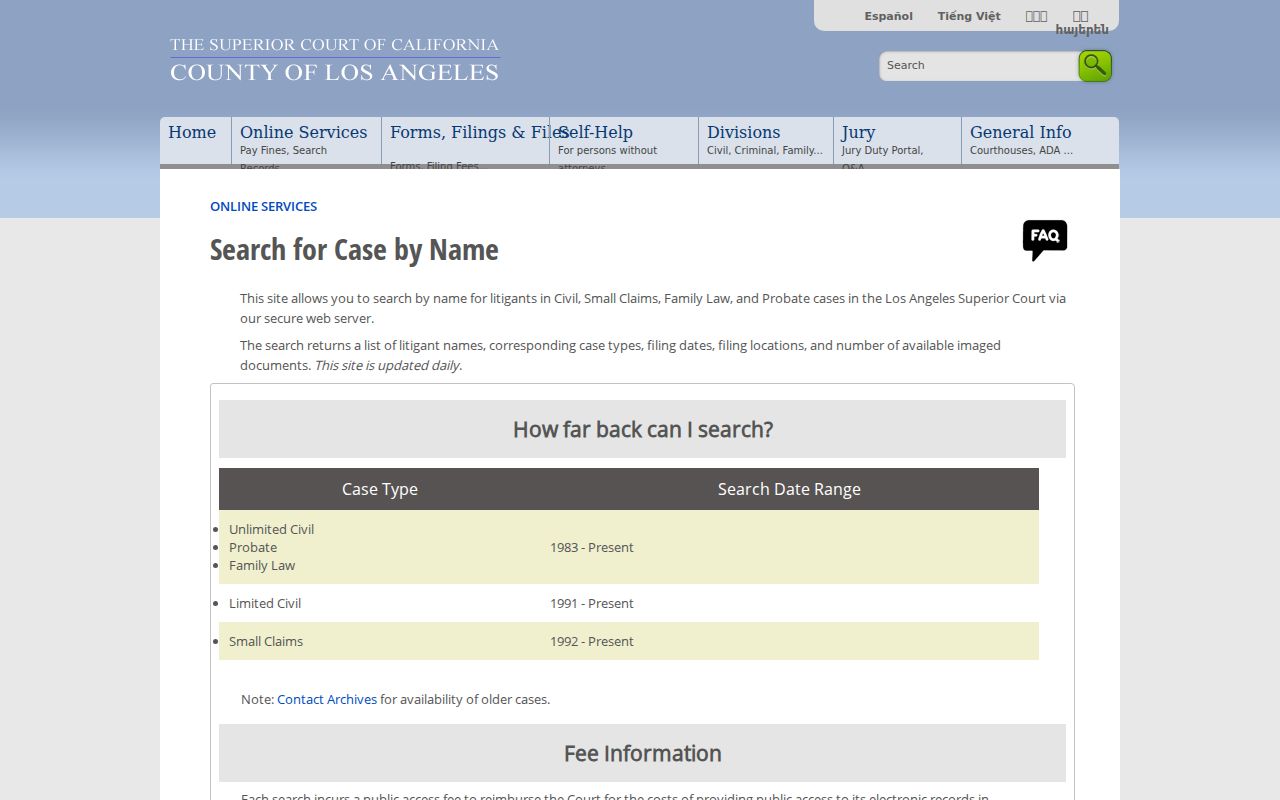
The search screen is an index, not the full court file. Sealed records and confidential adoption, juvenile, and paternity material may be absent. A name match needs a filing location, date, party role, or another independent clue before it is treated as the same person.
Access Monrovia Cases by Number
Case Access is the free case-number route. Enter the required Case Number and, when the interface requests it, use the optional Filing Courthouse selection for a limited-jurisdiction case. The button is labeled “Search/Access Case.” The online display is useful for a docket lead, but the court warns that web data is not the official record and may contain omissions or errors.
| Case number | The court's unique identifier for the file. |
|---|---|
| Case type | Civil, small claims, family, probate, or another displayed category. |
| Filing date and location | When and where the case entered the Superior Court system. |
| Caption and party roles | Named parties and labels such as plaintiff, defendant, petitioner, or respondent. |
| Status | The displayed posture of the case, which may not explain every later event. |
| Hearings | Future or listed hearing dates and courtroom information when public. |
| Register of actions | Docket events, filings, orders, and other recorded case activity. |
| Document links | Available electronic images or purchase links, subject to case type and closure rules. |
Scanned unlimited and limited civil and small-claims documents may be purchased at $1 per page for pages 1-5, then $0.40 for each added page, with a $40 maximum per document. Criminal and family-law images are not generally available online. Courthouse public-access computers can show electronic files without a viewing charge, and the clerk supplies certified copies when the request and fee rules allow.
Older material may require the Los Angeles Superior Court Archives and Records Center at 222 N. Hill Street in Los Angeles. It is open weekdays from 8:30 a.m. to 4:30 p.m., holds mainly 1910-2004 paper, microfilm, and digital matters, and provides public computers in Room 212. Call (213) 830-0198 to confirm images. Post-2004, misdemeanor, limited, and small-claims files normally stay with the originating courthouse.
Use Four Keys in a Monrovia Lookup
The LA County Voter Registration Status screen is a four-key verification form, not a public name browser or street directory. All four values are required before the form can test a registration match.
- Last name, entered as alphabetic text.
- Birthdate, entered as mm/dd/yyyy.
- Residence house number, entered as numbers only.
- ZIP Code, entered as numbers only.
Elections Code Sections 2180-2194 restrict voter-file access and use. The self-check screen cannot enumerate voters at a Monrovia address. Authorized file requests go through the county or Secretary of State application, require a permitted electoral, governmental, scholarly, journalistic, political, or qualifying purpose, and carry their own data and security rules. The state route lists a $100 file fee. A single application may list up to ten people, with a $30 charge per record capped at $100, subject to the current request rules.
Registration status can change through list maintenance, a move, a death record, or a confirmation process. Treat an old result as a clue. Safe at Home and other protected-address handling can produce a substitute or suppressed residence. A missing address is not proof that a person never lived in Monrovia, and voter data should never be republished as a block roster.
Request Monrovia Vital Records
For a Monrovia birth, death, or marriage event, the Los Angeles County Registrar-Recorder/County Clerk and California Department of Public Health-Vital Records provide different copy routes. California uses authorized and informational certified-copy categories rather than a simple age rule. Health and Safety Code Sections 103526 and 103526.5 govern birth and death copies. Family Code Section 509 controls confidential marriage copies.
The CDPH Vital Records service explains statewide forms and the county/state relationship. An authorized copy requires a statutory relationship or role and a sworn statement. An informational copy carries a legend that it is not valid to establish identity. County online vendors, mail, and in-person requests are separate access channels, and CDPH also accepts its form-based mail route.
- Record type, name on the certificate, event date and place, and relevant parent names.
- Requester name, address, phone or email, relationship, eligibility category, signature, and sworn statement.
- Number of copies, payment, mailing method, and notarization when a mailed authorized request requires it.
The CDPH sworn-statement instructions explain the authorized-copy signature and notarization step. Current 2026 CDPH fees are $31 for birth, $26 for death, $19 for public marriage, and $18 for a dissolution certificate. The search fee is retained when no record is found, and a Certificate of No Public Record is issued. Verify the current fee schedule immediately before mailing because forms and vendor charges can change.
Confidential marriage is narrower: a copy goes to a party or a person acting under court order under Family Code Section 509. Adoption records remain confidential. Birth-parent or adoption research must use CDSS/CDPH consent, information, or court channels rather than a public name search. A divorce certificate is an abstract from CDPH; the judgment and full file remain with Superior Court.
Verify a Monrovia Resident
A name match earns confidence only when two independent clues point to the same person. The county Assessor provides address and AIN search, but no public owner-name Internet route. When the address is unknown, ask about the Assessor public counter or Property Data Sales route, subject to access rules. A likely parcel can be checked through its legal description and a recorded deed at the Recorder's Norwalk office. Business, professional, and unclaimed-property searches may add an old address or affiliation, but they do not turn a name into a current residence.
- Normalize the surname, given name, middle initial, married name, compound surname, and likely spelling variants.
- Anchor the name to a known address or AIN through the Los Angeles County Assessor Portal. Keep situs and mailing address separate.
- Choose a second source. Use the same middle initial with a parcel or legal description, a spouse with a directory address, or an entity number with a filing address.
- Check that dates are plausible. A deed, court event, license, directory, obituary, or unclaimed-property report must fit the person's age and known timeline.
- Confirm the important fact with the custodian. Correcting a commercial compilation does not amend the deed, court, voter, or vital record that supplied it.
- Docket
- The running record of filings, orders, hearings, and other events in a court case.
- Index versus image
- An index points to a record through names or identifiers; an image is a scanned document and may require a separate fee or in-person access.
- Certified copy
- A copy issued or attested by the record custodian for an allowed purpose, with the certification needed for that use.
For an older address, pair the current clue with the Monrovia city directory collections. Directory, court, and vital sources answer different questions, so a mismatch is a prompt to investigate rather than a reason to force the records together.
Monrovia Resident Lookup for Heirs
Probate is a useful family-history route when the question concerns an heir or an estate. Los Angeles Superior Court's paid name search reaches probate cases from 1983-present. Older files route to the Archives and Records Center, which holds mainly 1910-2004 matters in paper, microfilm, and digital formats. An estate petition may identify heirs and addresses, but an heir is not automatically a current occupant.
For former classmates, Monrovia High School and Clifton Middle School yearbooks in the Museum and Legacy collections can supply a class, activity, or old spelling. Newspapers, obituaries, cemetery indexes, and death records can close a deceased resident's trail. Each source is a lead until the relevant library, court, or vital-record custodian confirms it.
Business-owner research follows a different path. Search the California Secretary of State bizfile for an entity name or number, then compare the filing with the county fictitious-business-name record and the California Department of Consumer Affairs license search. These records can show an entity, agent, license status, or public address. They establish affiliation only, not residence. A State Controller unclaimed-property result can be an old name or address clue, but its age must be tested.
Beyond Monrovia County Courts
Federal cases do not appear in the Los Angeles Superior Court index. The U.S. District Court for the Central District of California is the federal venue for many filings connected to Monrovia, and the official PACER service searches federal party and case indexes. PACER requires an account. Current prices and document charges should be checked at the time of search rather than copied from an old fee summary.
The federal result can help separate two people with the same name when a party role, district, case date, or filing address fits the known facts. It still does not certify a current Monrovia residence. Federal docket records and document images also follow their own access and sealing rules.
The PACER entry point shows the separate federal path for a Monrovia resident lookup.
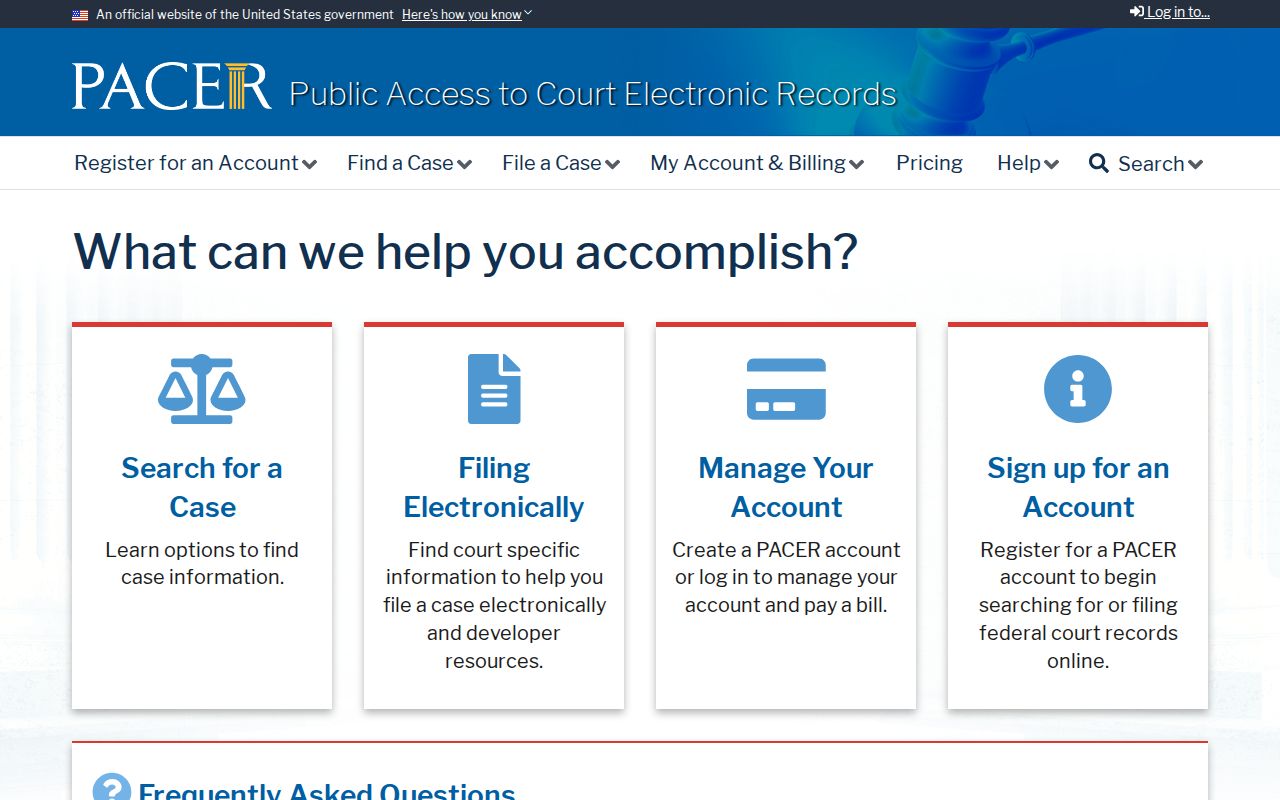
Use a federal case as one dated source among several. A party's contact or filing address may be old, protected, or supplied for a narrow case purpose.
Custody Is Not Monrovia Residency
County jail, state corrections, federal custody, and public-safety registry tools answer custody or statutory disclosure questions. They do not create a resident directory. A booking location can change quickly, a release date is not a home address, and a registry map is governed by its own public-safety limits. Arrest is not conviction.
The Federal Bureau of Prisons inmate locator is one official example of a custody search. The California CDCR CIRIS search is the state custody route. County systems can be used when their own search keys and disclaimers fit the question. The court case number, not a custody result alone, is the route for checking a public filing or outcome.
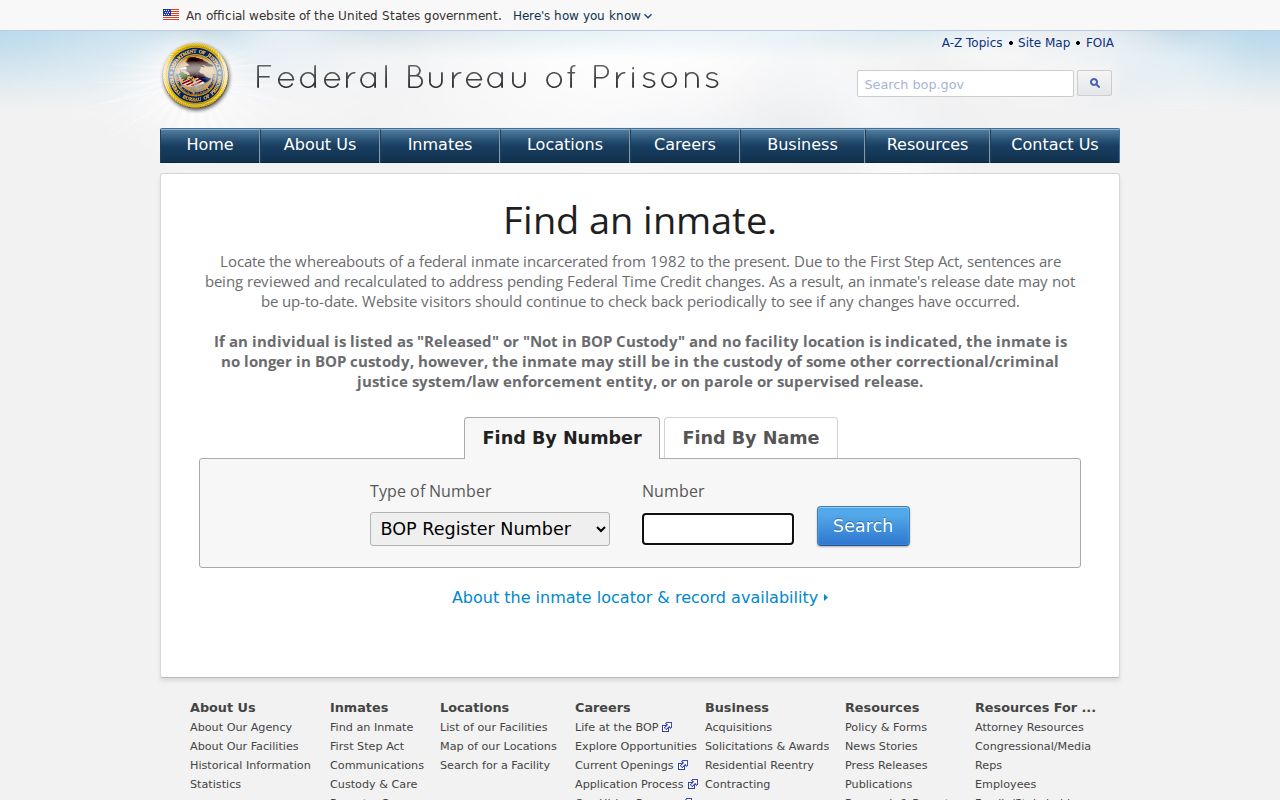
Use the narrowest official tool and follow its stated purpose. Do not infer that custody, an offender listing, or a police report proves that someone lives in Monrovia now.
Privacy Limits on a Monrovia Lookup
California privacy rules explain why a legitimate search may end with a blank field. Safe at Home supplies an eligible participant with a substitute mailing address and confidential mail-forwarding. The California Secretary of State Safe at Home program covers qualifying survivors and specified participants, and public agencies follow its protected-address rules. Do not defeat suppression by matching across databases.
The California Consumer Privacy Act and California Privacy Rights Act give covered-business rights to know, delete, correct, opt out of sale or sharing, limit certain sensitive-information uses, and receive nondiscriminatory treatment. Those rights do not erase lawfully retained court, deed, assessment, vital, or election records. The Attorney General's California privacy rights explanation distinguishes covered businesses from public custodians.
California's Delete Act created DROP, a single deletion request path for personal information held by registered data brokers. The California Privacy Protection Agency's DROP status page records that the regulations took effect January 1, 2026. DROP can affect registered broker data, not a lawful county record. Commercial opt-out work may also require identity-limited proof and later checks.
Lawful personal use. A Monrovia resident lookup is for personal, lawful research such as family history, records verification, or reconnecting. Public availability never authorizes stalking, repeated unwanted contact, threats, surveillance, or attempts to expose a protected address.
When a record appears wrong, contact the office that holds it and keep the source date. California voter restrictions, the Driver's Privacy Protection Act, address-confidentiality rules, and California stalking law all place limits around personal data. A missing result can be a lawful privacy outcome.