
Monrovia Previous Resident Sources
The previous residents of a Monrovia address are best traced when each source is matched to the question and the period. County title records reach farther back than local directories. Directories bridge the years when a person lived at an address. Permits date changes to the structure. Census schedules describe households at released dates, while newspapers, obituaries, and probate can explain a move, death, or heir connection. No row below is a complete list of occupants, and no gap should be filled with a guess.
| Source | Years it covers | Where held | What it shows |
|---|---|---|---|
| Recorder deed and name index | 1850/1851-present | RR/CC Norwalk | Recorded owners, transfers, liens, easements, and legal descriptions |
| Monrovia city directories | 1908-1971, with gaps | Heritage Room and selected Legacy items | Named occupants, spouse, occupation, and address |
| Permit Book and newer permits | 1911-1947; 1948-present | City, OnBase, CPRA, Community Development | Work, dates, applicants, contractors, and status |
| Local newspapers | 1886-1992 named runs | Library scans and databases | Moves, sales, social notices, obituaries, and family clues |
| Federal population census | 1790-1950 public | NARA, library, and genealogy databases | Household members, relationships, age, birthplace, and occupation |
| Monrovia Legacy Project | 19th century onward, ongoing | PastPerfect Online | Photographs, directories, house histories, documents, and ephemera |
The first useful choice is the period. For a present owner, begin with the parcel and deed. For a 1920 household, use a directory, census, local paper, and address index. For a deceased former resident, add obituary, cemetery, death-index, and probate evidence. The same address can have a title trail and a household trail that do not match exactly.
Note: The official guide does not publish a complete volume-by-volume publisher list, so each selected Monrovia directory title page must be checked.
Monrovia Deed Chain for Past Residents
The backward owner trail for previous residents begins with a current Monrovia situs address. Search the Los Angeles County Assessor by address or AIN, preserve the ten-digit identifier and legal-description shorthand, and note the assessed owner and tax mailing clue. Then take the likely owner and approximate acquisition year to the Recorder’s grantor and grantee index. The grantor is the party transferring an interest. The grantee is the party receiving it. Search the seller as an earlier grantee, then repeat until the title trail reaches the period of interest.
- Save the current parcel, situs, AIN, legal description, and mailing-versus-situs distinction.
- Find the current owner in the grantee index for the likely purchase year and retrieve the vesting deed.
- Read the deed for the grantor, grantee, recording date, instrument number, book or page, and legal-description reference.
- Search the grantor as a grantee in earlier years, checking parcel continuity to avoid a same-name mistake.
- Bridge title to occupancy with directories, permits, census, newspapers, obituaries, and probate rather than treating ownership as residence.
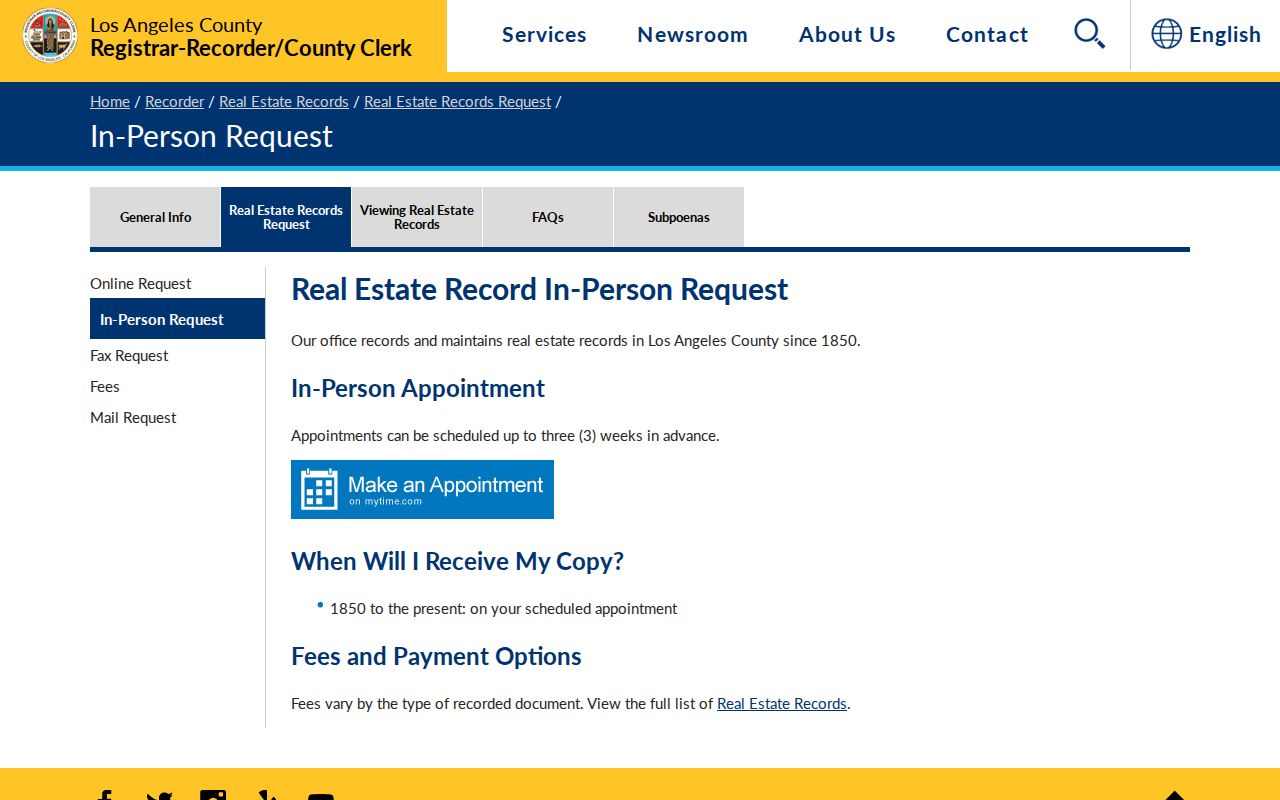
The Recorder in-person request route shows the practical next step for an identified document. The image below is a useful reminder that a known instrument or name-and-year clue is needed before a copy request can be targeted.
The follow-up chain should preserve the exact spelling printed in each index. A legal description is the land description that ties a deed to a lot, subdivision, map, or metes-and-bounds description. It is often more durable than an old street label.
- Grantor and grantee
- The grantor transfers the recorded interest; the grantee receives it.
- Chain of title
- The linked sequence of recorded transfers for one parcel.
- Legal description
- The formal land description that anchors a deed when an address changes.
- Criss-cross directory
- A reverse directory arranged by street and house number rather than only by surname.
- Enumeration district
- The census area used by an enumerator, useful when a household is hard to place by street name.
Norwalk Recorder Floor Split
Los Angeles County maintains real-estate records from 1850/1851 to the present, but the real-estate index has no public Internet search and the office does not perform telephone index searches. The alphabetical grantor and grantee books are searched by party name and recording year at the Norwalk headquarters. Records dated 1851-1957 are reviewed on the lower level. Records from 1958-present are on the second floor. That physical split is a practical clue for previous-resident work, especially when a chain crosses the mid-century boundary. The county’s privacy rationale also reflects Government Code section 7928.205, formerly section 6254.21, which restricts Internet posting of certain officials’ home addresses and telephone numbers after a written demand.
| Recorder clue | Type | Required | Format or use |
|---|---|---|---|
| Grantor or grantee name | Text | Yes | Search the alphabetical index; test spelling and name variants. |
| Recording year | Year or range | Focused search | Use the likely transfer year; give a range for mail research. |
| Document type | Reference label | Optional | Deed, deed of trust, lien, release, easement, or related instrument. |
| Instrument number | Text | After index match | Identifies the known document for a copy request. |
| Legal description or map reference | Reference field | Continuity check | Compare the parcel when an old street label no longer matches. |
The Recorder’s offline-index instructions explain why an address cannot simply be typed into a web deed portal. The policy is tied to protections for certain officials’ home addresses. Bring a party name, approximate year, and parcel or legal-description clue when tracing previous residents. An appointment supports in-person inspection, and a known document can be copied once the index identifies it.
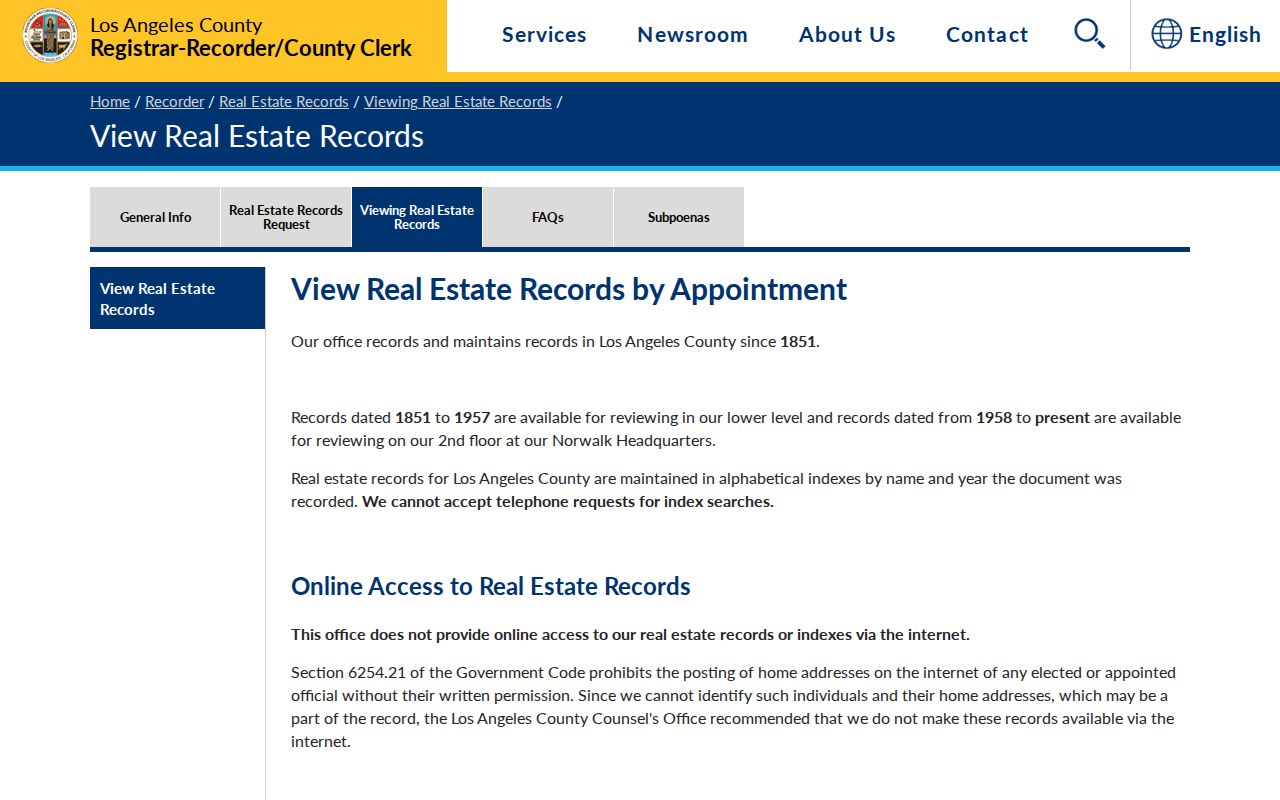
The offline index route makes the Norwalk visit part of the research method. It also explains why a remote address-only search cannot replace the name-and-year work.
Mail is a fallback after the index work is done. The request should name the indexed party and document, give the years to search when the exact year is uncertain, and use the office’s copy route. The published schedule lists a plain copy at $5 for the first page and $3 for each added page, a certified copy at $6 for the first page and $3 for each added page, a name-and-year search at $0.50 with a $1 minimum, expedited mail or UPS at $18.50, and card handling at $1.75. Processing is listed within 20 working days. Search charges are nonrefundable, and mail payment goes by check or money order to Real Estate Records, P.O. Box 1130, Norwalk, CA 90651-1130.
Note: The recorder’s lack of an online index is an access design, not evidence that older Monrovia deeds were destroyed.
Monrovia Permit Time Markers
Deeds show title changes, but permits can place a house, addition, or repair in a more useful time frame for previous residents. Monrovia’s About My House route connects researchers to zoning information, the county Assessor, OnBase, the 1911-1947 Permit Book, and historic-preservation material. The 2026 historical research guide describes newer permit material from 1948-present. Depending on the surviving record, a permit can name an applicant, owner, contractor, street address, permit number, issue date, scope of work, valuation, inspection, and final status.
For scanned city files, start with OnBase. If a file is absent, use the city’s Public Records Request Program and CPRA route. A request should describe an existing permit, plan, approval, or record series by address and time range. Under Government Code section 7922.535, the city normally determines within ten days whether responsive disclosable records exist and may give a written extension of up to fourteen days for unusual circumstances. Inspection is ordinarily free; direct duplication costs may apply to copies.
Community Development is the phone fallback for an uncertain build year at (626) 932-5565. Building Services is listed at (626) 932-5581 and building@monroviaca.gov. The city’s permit evidence is useful for dating a physical change, yet the named applicant or contractor is not automatically a past resident. A permit can also post-date a move or describe work ordered for an owner who lived elsewhere.
Monrovia Census Pairing
Federal census schedules supply a household layer that deeds and permits do not. The National Archives rule currently makes schedules from 1790-1950 public after a 72-year release period. A census entry can include household members, relationships, age, birthplace, and occupation as recorded by the enumerator. It is a snapshot, not a full list for every year, and the address may appear through an enumeration district or a nearby street sequence rather than a modern parcel label.
The National Archives census collection is the official release reference. Pair a directory year near a census year, then test the previous residents trail against the same surname, spouse, age, birthplace, and address clues. A directory may show a move that falls between census dates. A census may show relatives or boarders that a directory leaves out. A missing name can reflect timing, spelling, enumeration limits, or a directory gap.
- Write down the directory name, street label, house number, spouse clue, and occupation exactly as printed.
- Check the nearest public census year and search the household by name, age, birthplace, and enumeration district.
- Compare the next directory and census pair for a changed address, new spouse, child, or altered surname.
- Use a newspaper, obituary, or probate file to test whether a disappearance reflects death, a move, or a record gap.
Directory absence is never enough to say that a person left Monrovia. A gap in the 1908-1971 city-directory run, a moved home, or a changed street label can break an otherwise sound search for previous residents.
Monrovia Legacy Address Clues
The Monrovia Legacy Project adds a local history layer to the county trail of previous residents. Its free PastPerfect catalog includes photographs, documents, directories, telephone books, house histories, biographies, and ephemera. The project reported nearly 10,000 digitized items in March 2025, with more additions planned. Search can use combined terms with AND, and the controlled vocabulary includes People, Search Terms, Subjects, and exact place terms. An item can have a catalog record without a downloadable image, so record the object title, address, narrative, record type, and image status.
The Legacy creator search for Monrovia address records shows how a catalog result can connect a person, street, and historical description.
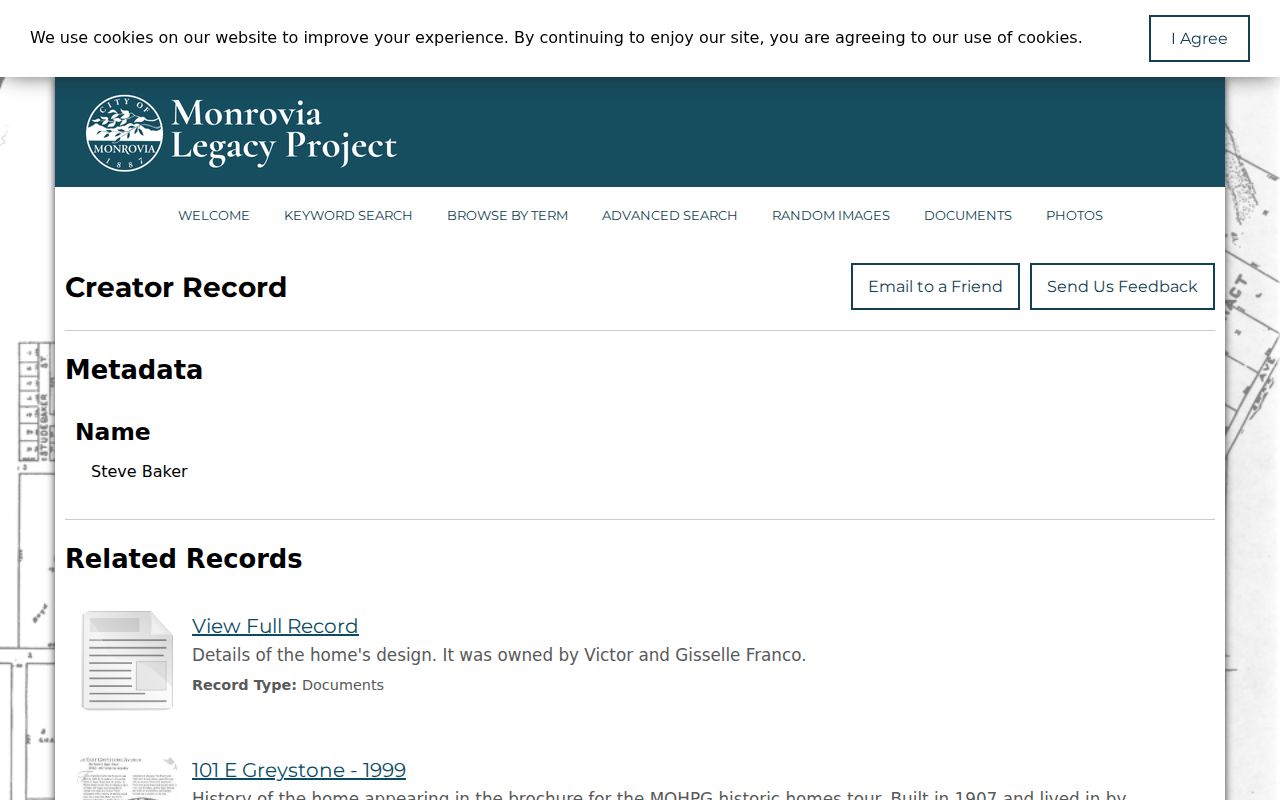
That catalog view is a lead, not a substitute for the underlying deed or a complete occupancy roll. It can point toward the right house file, directory year, or local narrative.
The Legacy residence search results show the address-keyed side of the collection.
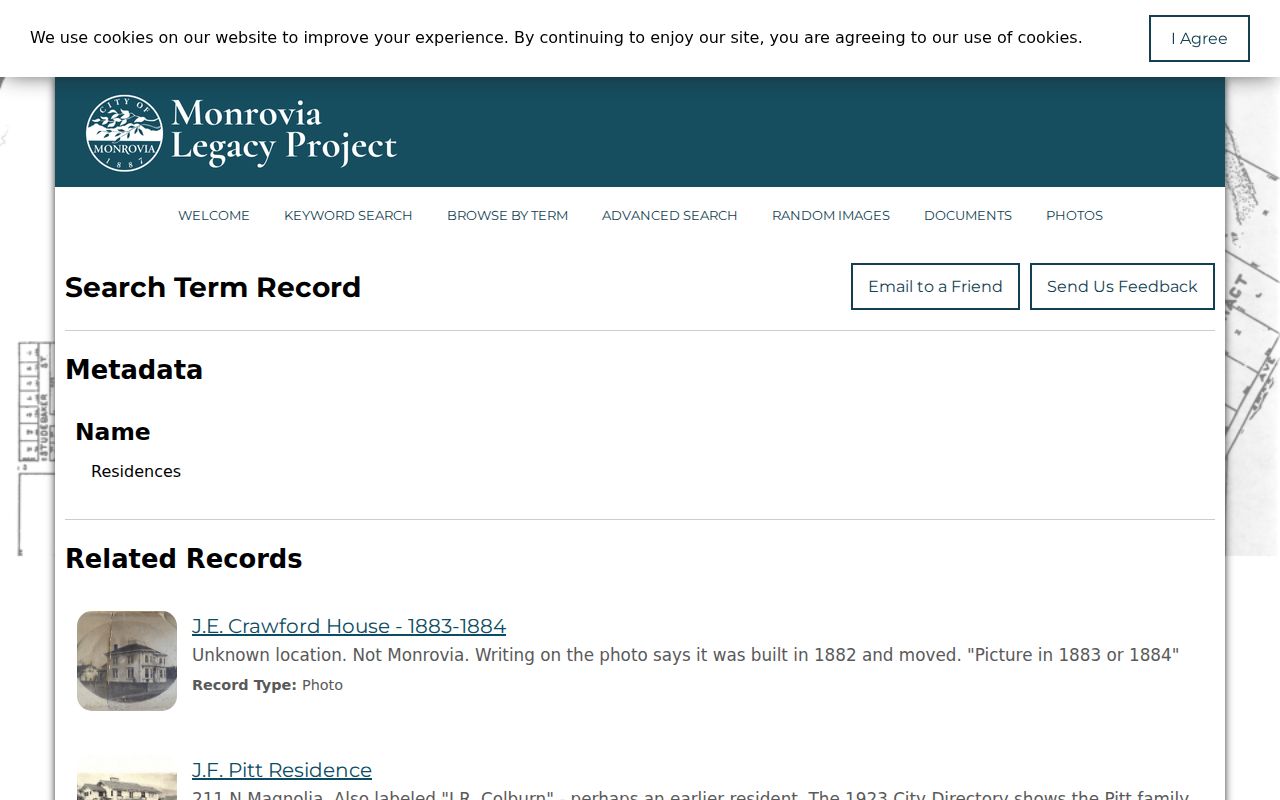
Use a catalog address to locate a cited local book, photo, or house history, then compare its dates with the deed chain and directory. Images may be downloaded for personal use under the collection policy, while prints can be ordered through the project contact.
Note: PastPerfect search terms and image availability vary by item, so an empty result is not a complete search of every Monrovia paper record.
Monrovia Court Probate Trail
Probate can close a previous-resident trail by identifying an estate, heirs, or a filing date, but it belongs to the Los Angeles Superior Court system. The paid civil, family, and probate party-name index reaches mostly from 1983-present. Limited civil coverage begins in 1991 and small claims in 1992. A guest name search costs $4.75, while registered pricing changes by monthly search volume, and a no-match still incurs the search charge. Case Access by case number is free, but web information is not the official court record for past residents.
The Los Angeles Superior Court party-name search can return a party name, case type, filing date, filing location, and count of available imaged documents. Sealed records and confidential categories remain unavailable. An estate petition may identify heirs, yet an heir is not automatically a current occupant.
The Archives and Records Center at 222 N. Hill Street in Los Angeles holds mainly 1910-2004 matters in paper, microfilm, or digital formats. Public computers in Room 212 can index and display cases. The center is open weekdays from 8:30 a.m. to 4:30 p.m.; the published contact number is (213) 830-0198. Post-2004, misdemeanor, limited, and small-claims cases normally remain with the originating courthouse.
The court Archives and Records Center access page is shown below. It matters when a former Monrovia resident’s probate or older civil file is outside the ordinary online name-search window.
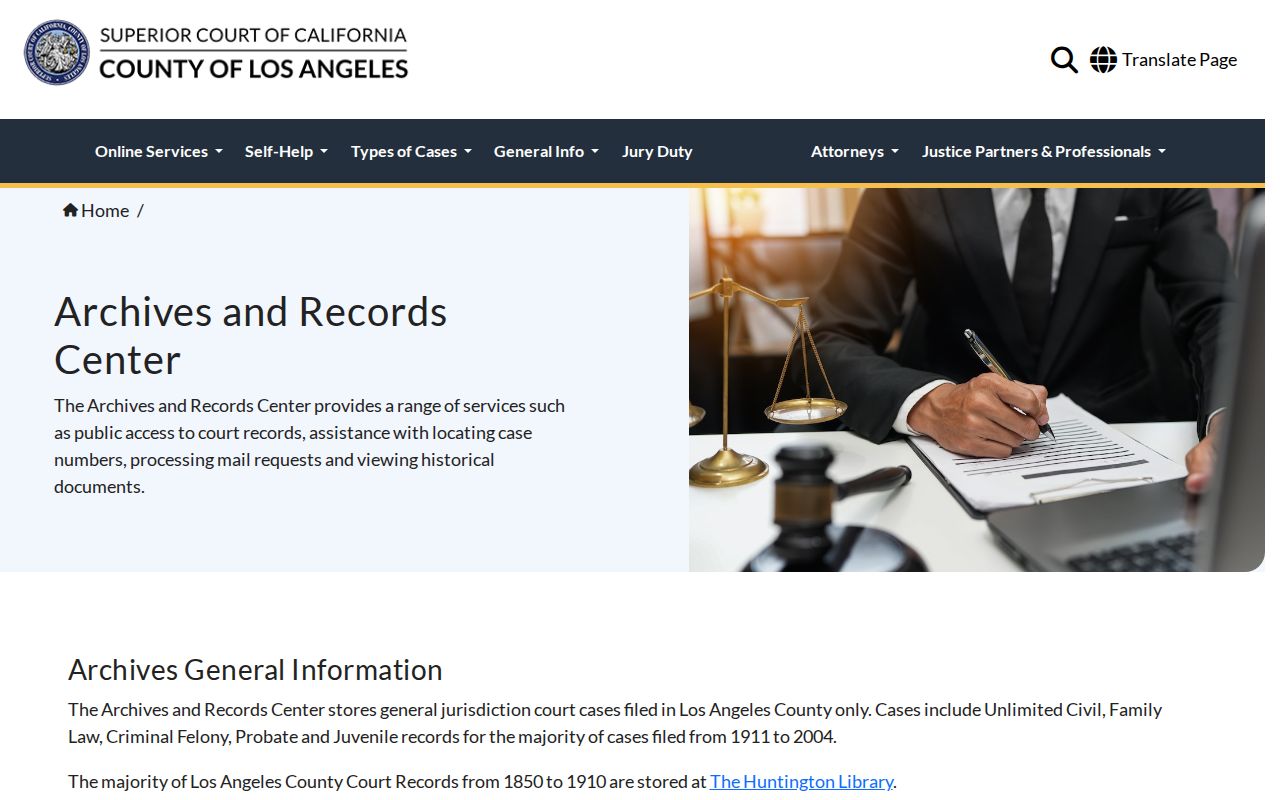
The archive route can supply a file location or image path, not a promise that every document is open. Ask the clerk about certified copies when a legal filing must be relied upon.
Monrovia Moved House Clue
Monrovia’s built history contains a direct warning against treating a street address as permanent when tracing previous residents. The city documents one surviving house built in 1887 or earlier that now stands at 323 Heliotrope after being moved from Wild Rose and Jasmine. The example is specific, but the method applies more broadly: compare parcel geometry, legal description, permit chronology, directory sequence, and local house-history notes before deciding that two address labels describe two different homes.
Nine tracts were platted in 1886 and nearly forty existed by the end of 1887. Later records can therefore use a subdivision or tract name that is not visible in a modern street search. The legal description and AIN help keep land continuity intact. A directory follows the name printed for that year, while a permit may describe the move or alteration and a deed follows the parcel interest.
Sanborn sheets can supplement footprint research, but the exact Monrovia sheet years were not located in the research run. No sheet date, street number, or building use should be invented from a general map collection. When the old label does not resolve, note the gap and return to the custodian, library index, or permit record.
Monrovia Past Household Clues
Occupancy evidence grows when a directory is read beside the local newspaper chain. Monrovia titles run from the Planet in December 1886 through the Messenger, News Weekly, Daily News, Daily News Post, and News Post, which continues through July 1992. Library scans and staff newspaper databases can reveal a move, sale, social notice, death, or family link that an index misses. Search more than one title because a title change can hide a resident from a one-paper query.
Obituaries and cemetery records can mark the end of an address association. Probate can connect a deceased person to heirs, but the file should be checked through the court or archive rather than assumed from an obituary. The library’s Street Address Index, clipping files, local books, and Legacy catalog can add biography to a deed chain. For current parcel work, the Monrovia street directory keeps the address-to-AIN sequence separate from the historical household layer. The full shelf and year details are organized in the Monrovia city directory collections.
Lawful house history. Previous-resident research is for family history, personal house history, and careful civic study. Owners are not all occupants, and renters or household members may not appear in public records. Never use a past address to stalk, harass, track, intimidate, or harm a living person.
Keep a source date with each clue. A name can recur. A household can move between directory years. The Safe at Home program can replace or suppress a qualifying participant’s address lawfully. When the evidence stops, record the gap instead of turning a partial trail into a claim about every previous resident.