
Monrovia City Directory Holdings
Monrovia's historical directory trail has two strong local custodians and a growing online catalog. The Heritage Room preserves the library's city directory run, while the Historical Museum's Trentalange Research Center reports an earlier searchable set with selected streets in later years. Legacy adds catalog records for directories, telephone books, photographs, and house histories. The newspaper shelf and yearbook files fill gaps when a name vanishes from a directory.
| Collection | Years | Where Held | Access |
|---|---|---|---|
| Monrovia library city directories | 1908-1971, with gaps | Heritage Room, 321 S. Myrtle Avenue | Appointment, in-library use, ID and staff retrieval |
| Trentalange directory records | 1888-1917, plus selected streets in other years | Historical Museum Research Center, 742 E. Lemon Avenue | Volunteer-run search and research contact |
| Legacy directories and telephone books | 19th century onward, item-specific | PastPerfect Online catalog | Free catalog; item media varies |
| Local newspaper runs | 1886-1992, fragmented by title | Heritage Room digitized collections | Library assistance and local-history appointment |
| Yearbooks and house files | Years vary by item | Trentalange Center, Heritage Room and Legacy | In person or through a catalog item |
The sets overlap without being duplicates. The library's 1908-1971 run has gaps, and the Museum's 1888-1917 figure describes searchable records rather than a complete scan of every printed volume. The official research guide does not publish an exhaustive publisher-by-year list. Each volume's title page should supply its own title and publisher. Calling every Monrovia directory a Polk directory would turn an unverified assumption into a false collection history.
Monrovia Heritage Room Directories
The Monrovia Public Library local-history desk places the Heritage Room at 321 S. Myrtle Avenue and lists (626) 256-8274 for help. Local-history requests are appointment-only with a reference librarian. Most material is meant for use inside the library. Selected items require identification and staff retrieval, so a request for a year or address should be made before arriving rather than treated like an open shelf checkout.
The room's useful finding aids include the Street Address Index, the Homes and Home Tours clipping-file index, indexed local histories, architectural and historic-home books, digitized newspaper runs, and Legacy records. The Historical Research Guide also distinguishes the 1911-1947 Permit Book from newer permit material. That distinction matters when a volume shows an occupant but a house question needs construction or alteration context. Library staff can retrieve the cited book or clipping file, while the online catalog can point to a related item without promising that the entire source is digitized.
Bring the exact street spelling, a known house number, and the likely year range. The Street Address Index can lead to a page in one of five local history books. It is a better first move than leafing through every surname when the question begins with a house.
Note: Heritage Room access is appointment-based, so a catalog hit and an available reading copy are not always the same thing.
Monrovia Legacy Directory Search
The Monrovia Legacy Project catalog is the main online doorway to local photographs, documents, directories, telephone books, biographies, and house histories. Search terms can be combined with AND. The catalog also uses controlled vocabulary for People, Search Terms, and Subjects. Exact street terms, named houses, and place terms can work when a broad name search is noisy. Search “business directory” or “telephone” when the need is a phone or trade volume rather than a general directory.
Use the Legacy catalog search to see how a Monrovia city directory record is presented before requesting a physical volume.
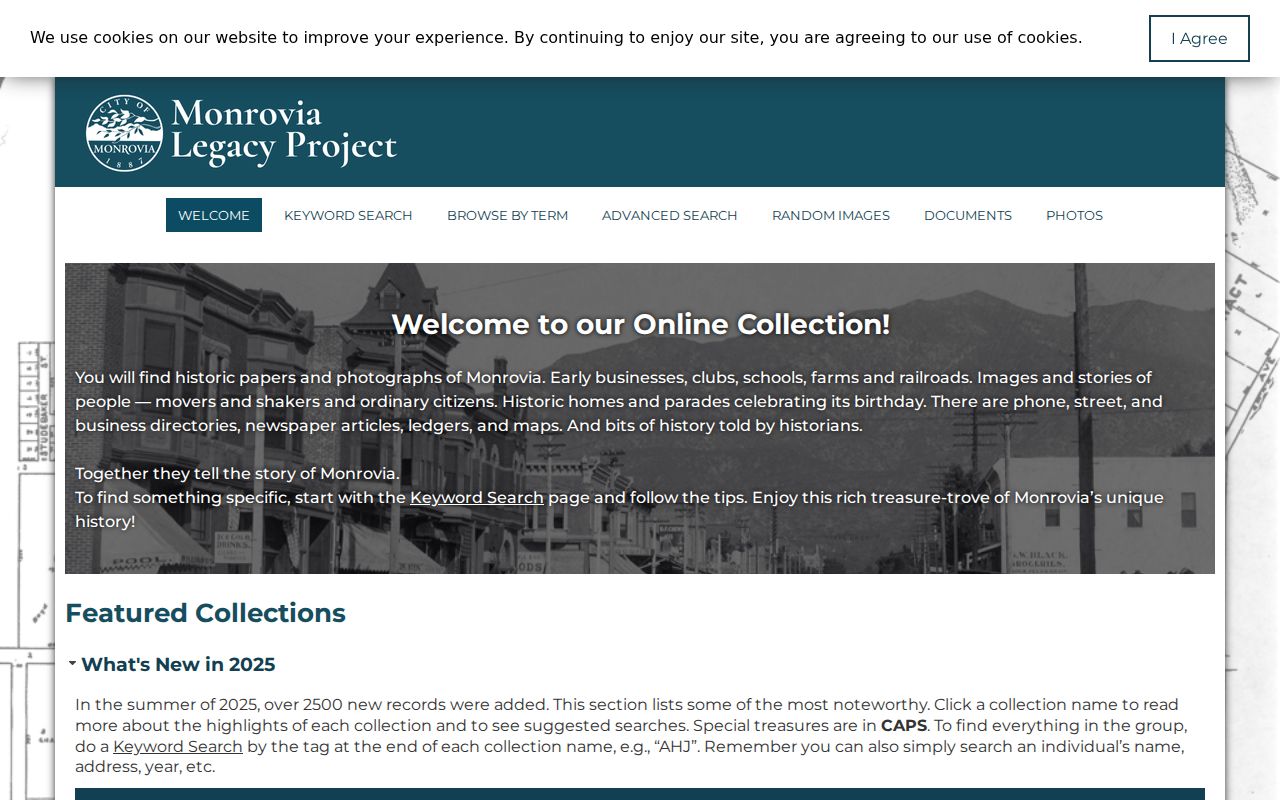
The catalog view is a finding aid, not a promise that every page has an image. A real April 1914 result is titled Monrovia Telephone and Telegraph Company Directory and includes “Bortells, Frank L.” at Shamrock and Wild Rose. Another catalog record is Monrovia, Arcadia and Duarte Directory 1928 Part 1. Those entries establish actual local titles and search clues. They do not establish one publisher for every year.
The Legacy creator results and residence records show why a directory search can widen into house history. Catalog metadata may include an object title, address, narrative, record type, and image status. Download or print choices follow the Historical Society's stated policy for the selected item.
Trentalange's Monrovia Directory Records
The volunteer-run Trentalange Research Center at the Historical Museum is a separate research route at 742 E. Lemon Avenue, (626) 357-9537. The Museum reports more than 9,000 searchable city-directory records for 1888-1917, with selected streets represented in other years. Its broader holdings exceed 11,000 artifacts and documents and include tract and subdivision maps, Monrovia High School and Clifton Middle School yearbooks, founding-family files, house files, and institutional histories.
The earlier date range is important. It reaches into Monrovia's first decades and can supply a name before the library's 1908 shelf begins. It should still be described as a Museum database and collection, not folded into the Heritage Room count. Volunteer research help may identify a street, family, or founding-era file that a free-text catalog query misses.
See the Monrovia historical collections overview for the relationship among the city library, Museum, and Legacy Project.
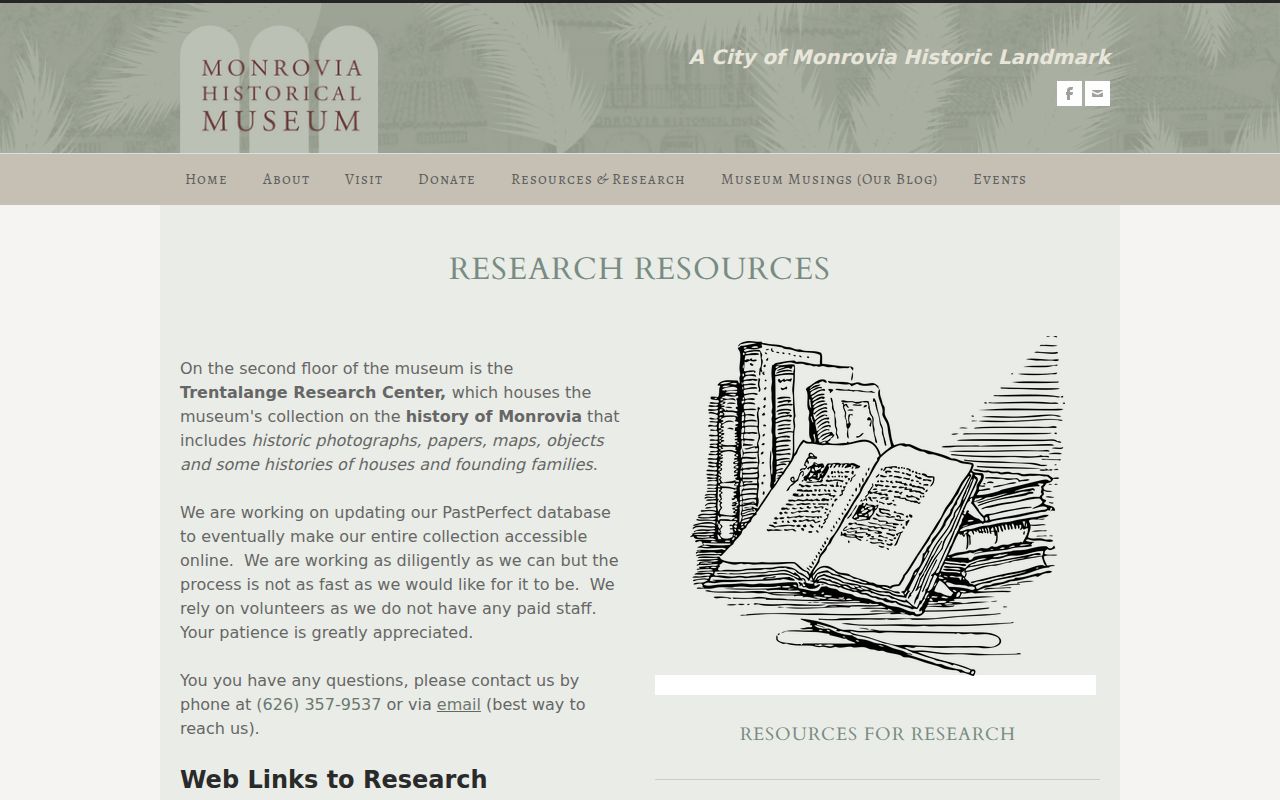
The Museum collection view adds context that a single alphabetical name entry cannot: tract names, school ties, house files, and local artifacts can help distinguish two people with the same surname. Use those clues to guide the next archive or newspaper search.
Read a Monrovia City Directory
A typical Monrovia city directory entry should be copied field by field before it is interpreted. The printed form can vary by volume. The local guide confirms that occupations, spouses, and sometimes children may appear with the householder. An address section or reverse directory changes the order and starts with the street instead of the surname.
| Name | Surname, given name, and middle initial; a spouse may follow in parentheses. |
|---|---|
| Family clue | Widow notation or a child reference can explain a later name change. |
| Occupation | The printed occupation or business line helps separate people with the same name. |
| Address | House number and street, copied with the original spelling and direction. |
| Owner or renter mark | Record a symbol only when that volume defines one, and photograph its key. |
| Cross-reference | A reverse or criss-cross entry may connect a street address back to a name. |
“Bortells, Frank L.” at Shamrock and Wild Rose is a useful catalog example because it shows how a short entry can anchor a name to an intersection. It is not a stable full-page entry image or a complete household roster. The research run did not locate an official scan that exposes a complete Monrovia entry and abbreviation key. Inspect the selected volume's front matter before quoting a mark.
- Criss-cross directory
- An address-ordered section that lets a researcher start with a street and house number, then identify the listed occupant.
- Householder index
- The alphabetical name side that gathers the primary listed resident or household head, subject to that volume's rules.
- Abbreviation key
- The volume's explanation of short forms and symbols. Read it before treating an occupation, status, or address mark as fact.
Monrovia Newspapers Bridge Directory Gaps
When a city directory skips a year, the Heritage Room's digitized newspaper chain can supply a move notice, obituary, property story, social item, or business reference. The titles changed over time, so a search limited to one newspaper misses part of Monrovia's record trail.
| Collection | Years | What It Can Add |
|---|---|---|
| Monrovia Planet | December 1886-June 1888 | Early names, notices, and town events |
| Monrovia Messenger | July 1888-March 1891; May 1908; January-December 1909; July-December 1915 | Fragmentary household and community clues |
| Monrovia News Weekly | 1907-1912 | Local news beside early directory years |
| Monrovia Daily News | February 1910-February 1929 | Moves, deaths, civic and business notices |
| Monrovia Daily News Post | March-June 1929 | Short transition run |
| Monrovia News Post | July 1929-July 1992 | Later obituaries and address-linked stories |
Newspaper coverage is not a substitute for a directory entry. It is a way to test whether a person moved, died, married, joined a group, or appeared in a public local event during a missing year. Obituaries and probate references can close a household trail, but a published memorial still needs confirmation from the proper death or court custodian when the fact matters.
Trace Monrovia Directory Households
Begin with the strongest known clue. A street and house number can be more stable than a common surname, while a full name and middle initial can narrow an address search. Work from the local index to the annual volume, then test the result against nearby years.
- Start with the Street Address Index or a reverse directory when the house is known. Retrieve the cited history page or annual volume.
- Copy the occupant exactly, including initials, spouse notation, street spelling, and any status symbol.
- Check the preceding and following directory years. Note a new spouse, an occupation change, a changed street label, or a move.
- Pair the directory evidence with the 1910, 1920, 1930, 1940, and 1950 federal census schedules. The census is released on a 72-year rule, so later schedules are not yet public.
- Use newspapers, obituaries, cemetery evidence, or probate to test a death, an heir relationship, or a final address.
For a current address-keyed chain, the Monrovia by street records page is the natural next step. A directory disappearance can mean a move, death, delayed publication, an unlisted household, or a gap in the run. It cannot prove that a home was empty.
Note: Pairing a name with a spouse, address, occupation, or legal description is safer than treating one surname as a complete identity match.
Pair Monrovia Directories with Censuses
The National Archives census collection makes federal population schedules through 1950 available under the 72-year release rule. Census schedules can add household relationships, age, birthplace, and occupation fields that a city directory may shorten. They are still snapshots, not a year-by-year resident list.
- 1886-1888: Planet begins the named local newspaper trail.
- 1888-1917: The Museum reports searchable Trentalange directory records, with selected streets in other years.
- 1908-1971: The library holds city directories with gaps and appointment-based access.
- 2025: Legacy updates reported nearly 10,000 digitized items, with more telephone directories and yearbooks announced in August.
Use a directory year to anchor a household, then use the nearest released census decade to test relationships and age. A spouse's name, a distinct middle initial, or a consistent street can separate two Monrovia families. The census may list a different address or a different spelling, so preserve the printed form and explain the reason for any match.
Compare the federal schedules with a census research record after the local directory entry has been transcribed.
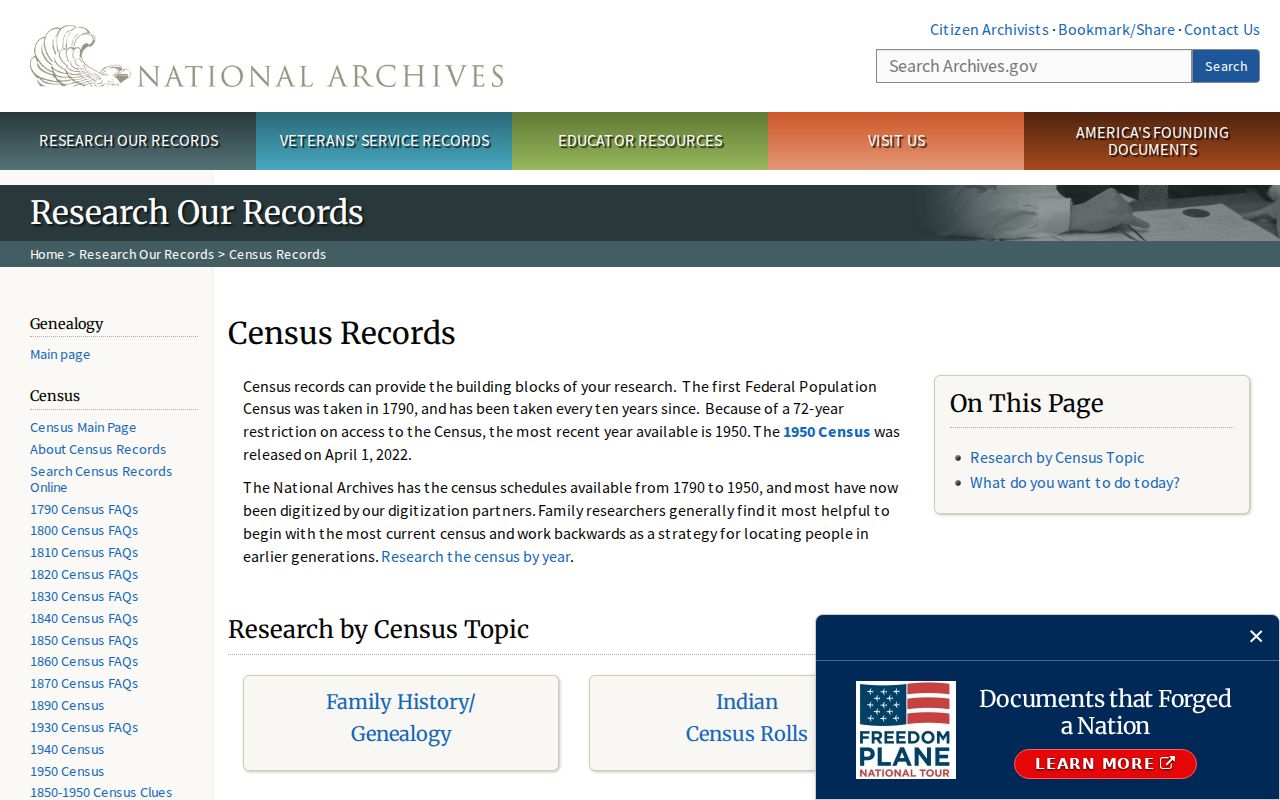
The census view supplies a second source for household structure. It does not erase a directory gap, and it should not be used to infer a present-day Monrovia resident from an old schedule.
Check Each Monrovia Directory Title
Publisher names are a research detail, not a safe shortcut. The official guide identifies the local collections but does not provide a complete volume-by-volume publisher list. Record the title, publisher, year, section order, and abbreviation key from each physical or cataloged volume. The known examples include the April 1914 Monrovia Telephone and Telegraph Company Directory and the 1928 Monrovia, Arcadia and Duarte Directory, Part 1.
Research gap. No exhaustive publisher-by-year inventory or stable full entry image was located. Label that gap plainly, inspect the title page, and avoid calling every local directory a Polk volume.
The Legacy Project reported nearly 10,000 items in March 2025 and announced about 2,500 more planned for that summer. Its August 2025 update added telephone directories and Monrovia High School yearbooks. Those additions can change which name, class, or address clue is available online, but they do not replace the Heritage Room or Museum when a selected item needs staff retrieval.
Lawful personal research. Historical names and addresses support family history, house history, and civic research. Do not use directory clues to stalk, harass, or harm anyone, and respect a protected or withheld address.
When a historical entry needs a present-day identity check, use the Monrovia resident lookup and match the old clue to current records with dates and more than one source.