
How Monrovia Residents Are Found
A name, address, or date points to a different record keeper. The Assessor starts with a Monrovia situs address or AIN, the ten-digit parcel identifier used to join a map to a tax record. A deed is stronger evidence of title than an assessment display. A court index identifies a party to a case, not everyone in a household. A directory or newspaper can show an occupant at a point in time, but an empty year does not prove that nobody lived there.
A sound residents directory search moves from the least costly clue to the record that can verify it. Keep the spelling exactly as printed, then test initials, married names, compound surnames, and a middle name. The sequence below is a practical first pass for Monrovia research.
- Write down the known name, date range, street form, city, and reason for the search.
- Use the Los Angeles County Assessor Portal by address or AIN, saving the situs, legal-description shorthand, and parcel facts.
- Use a lawful, identity-gated voter status check only when the last name, birthdate, house number, and ZIP are already known.
- Take a likely owner and approximate year to the Los Angeles County Registrar-Recorder/County Clerk name-and-year index in Norwalk.
- For an older household, pair the Heritage Room, Legacy, newspaper, census, probate, and vital-record clues before drawing a conclusion.
The Offices Behind Monrovia Records
Monrovia is an incorporated San Gabriel Valley city, but its resident-record trail is divided among City Hall, Los Angeles County, and California agencies. City Clerk staff can route OnBase documents and California Public Records Act requests. The county holds the assessment roll, deed records, court files, vital copies, and election registration. State systems add business entities, professional licenses, custody records, and confidentiality services.
Each office answers a narrower question than a master resident list would. The Recorder shows recorded parties and legal interests. The Assessor links a parcel to assessment facts. The elections office verifies a known registration. The library and museum preserve the historical record that modern portals do not replace.
Los Angeles County RR/CC
Real Estate Records, Norwalk headquarters
12400 Imperial Highway, Norwalk, CA 90650
(800) 201-8999
Los Angeles County Assessor
Address and AIN property search
Los Angeles County, California
Owner-name Internet search unavailable
LA County Elections
Voter Registration Status
12400 Imperial Highway, Norwalk, CA 90650
(800) 815-2666
Monrovia's AIN Property Search
The Assessor Portal is the best online starting point for an address-led residents directory search. Its main control is “Search by AIN or Address,” with Basic Search, Legal Search, and Map Search modes. A failed address can reflect a corner lot, a multiunit or commercial situs, vacant land, or a newly configured parcel. “VAC/VIC” means a vacant parcel in the vicinity of a displayed feature, not a precise deliverable address.
Save the AIN before moving to another source. Parcel details can show situs address, legal-description or subdivision shorthand, tax-rate area, land and improvement values, building year, square footage, units, lot size, and map links. The public portal does not provide a general owner-name Internet search. Assessed ownership and mailing information must be read as parcel evidence, not as a list of people inside the home.
| Field | Type | Required | What to record |
|---|---|---|---|
| AIN | Text | Alternative | Ten-digit parcel identifier; preserve leading zeros and punctuation |
| Street Address | Text group | Alternative | House number, direction, street name, and suffix |
| City | Field or list | Usually with address | Try Monrovia and postal-name variants when a match fails |
| ZIP Code | Text | Optional by portal version | Narrows the address; it is not a city-limit test |
| Parcel detail | Result view | After search | AIN, situs, legal description, values, year built, and map |
For a map check, use the Los Angeles County Parcel Viewer to click the target polygon and adjacent parcels one at a time. A parcel outline helps organize the search. It is not a surveyed boundary or proof of who occupies a building.
Note: A matching owner mailing address can support a lead, but it still does not establish every resident at the situs.
The Assessor’s parcel result is a roll, meaning an assessment record organized around property rather than a household. The AIN joins it to a parcel map. A legal description identifies the lot or subdivision in terms that can survive a street-label change.
- Roll
- An assessment record for a parcel, with values and property characteristics.
- AIN
- The Assessor Identification Number used to retrieve a specific parcel.
- Situs address
- The physical location assessed, distinct from the owner’s tax-mailing address.
- Index
- A finding aid that points to a fuller record, such as a deed or case file.
Monrovia Deeds at Norwalk
Los Angeles County has no public Internet deed index. The Recorder keeps alphabetical grantor and grantee indexes by name and recording year at the Norwalk headquarters. This design is deliberate. The county cites address-protection concerns tied to Government Code §7928.205, formerly §6254.21, so a remote address search is not a missing button.
Bring the current owner name, likely prior names, AIN or legal description, and an approximate year. Records dated 1851 through 1957 are reviewed on the lower level; 1958 to present is on the second floor. Appointments support viewing and known-document copy requests. If the document is identified, a mail request can use the indexed party, recording year, and instrument information. A targeted name-and-year request is different from asking staff to search a street.
The index can return grantor, grantee, document type, recording date, instrument number, book and page for older records, and a legal-description or map reference. The recorded image may add vesting language, return address, signatures, and a notary block. A deed’s party list is a title clue. It is not an occupancy list.
Norwalk fallback. When an online address search ends at the Assessor, carry the AIN and the likely name to the RR/CC index. The office records reach 1850/1851 to the present, even though the index is not online.
Monrovia Voter Status Checks
The LA County Voter Registration Status form verifies one known registration. It is not a Monrovia street directory and cannot list everyone at an address. The form requires the last name, birthdate, residence house number, and ZIP. A result can support identity matching when those four keys are already known, but it should not be used to build a block list.
California Elections Code §§2180-2194 restricts voter-file access to permitted electoral, governmental, scholarly, journalistic, political, and related uses. Social Security numbers, driver’s-license or state-ID numbers, and signatures are confidential. A dated Reports of Registration can add aggregate Monrovia context, never a named list. Safe at Home and other protections can make a lawful address absent or substituted.
The official voter status page is useful when a person supplies the needed information and the purpose is lawful. It answers “does this known registration match?” It does not answer “who lives on this street?”
These fields are visible in the form:
- Last Name: alphabetic text
- Birthdate: date in month/day/year format
- House Number: numbers only for the residence
- ZIP Code: numbers only
LA County Voter Registration Status is therefore a verification tool, not a residents directory source for open-ended browsing. The form’s four-key design is visible in the captured county lookup screen.
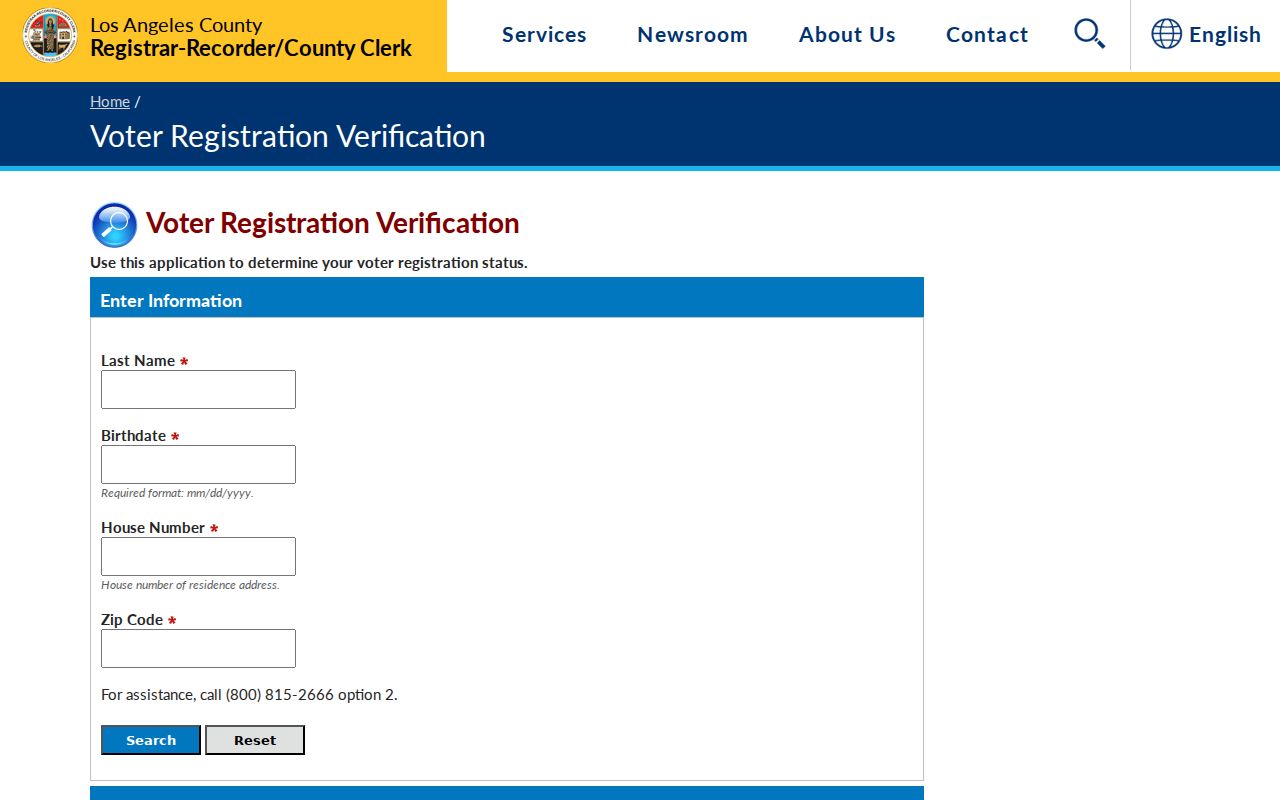
The form can confirm a known match, but it cannot enumerate the people at a Monrovia address.
Current Monrovia Resident Sources
Current records work best as a set of partial views. The assessment roll can identify an assessed owner and parcel. The voter form can verify one registration. The Monrovia staff directory identifies public employees and official contacts. Business and license records can connect a person to an entity or credential. None of those sources alone establishes a complete household.
| Source | What it can show | Keeper | Access |
|---|---|---|---|
| Assessor parcel roll | Situs, AIN, assessed owner and property facts | LA County Assessor | Free address/AIN portal |
| Voter status form | One known registration match | LA County Elections | Four required identifiers |
| Recorder index | Recorded parties, liens, easements and transfers | LA County RR/CC | Norwalk appointment |
| City staff directory | Staff name, title, department, phone and email | City of Monrovia | Free online browse |
| Business and license files | Entity, agent, license status and affiliation | California and city offices | Free portals; rules vary |
A “directory” here means a searchable set of entries, not proof that the entries describe the same kind of person. The city staff list is not a household roll. A business address is affiliation evidence. A property roll centers on land. To verify one person, compare at least two independent links and keep the source dates.
Monrovia Business and License Clues
Some resident questions are really affiliation questions. California Secretary of State bizfile can show an entity’s legal name, number, type, status, formation jurisdiction, agent, filings, and principal or mailing addresses. The Department of Consumer Affairs search can narrow a professional by board, license type, name, number, city, or county. Los Angeles County fictitious-business-name records and Monrovia’s monthly active-business list add local context.
Monrovia’s monthly active-business list is a public lead, not a certification of accuracy, standing, validity, or compliance. Home occupations are omitted for confidentiality. An agent address or business address should never be rewritten as a residence. Cross-check the entity number or license number, then compare the date and city with the person record being studied.
The California Department of Consumer Affairs search supplies the clearest license starting point. The screenshot below shows the kind of state-level professional lookup that can separate two people with the same name.
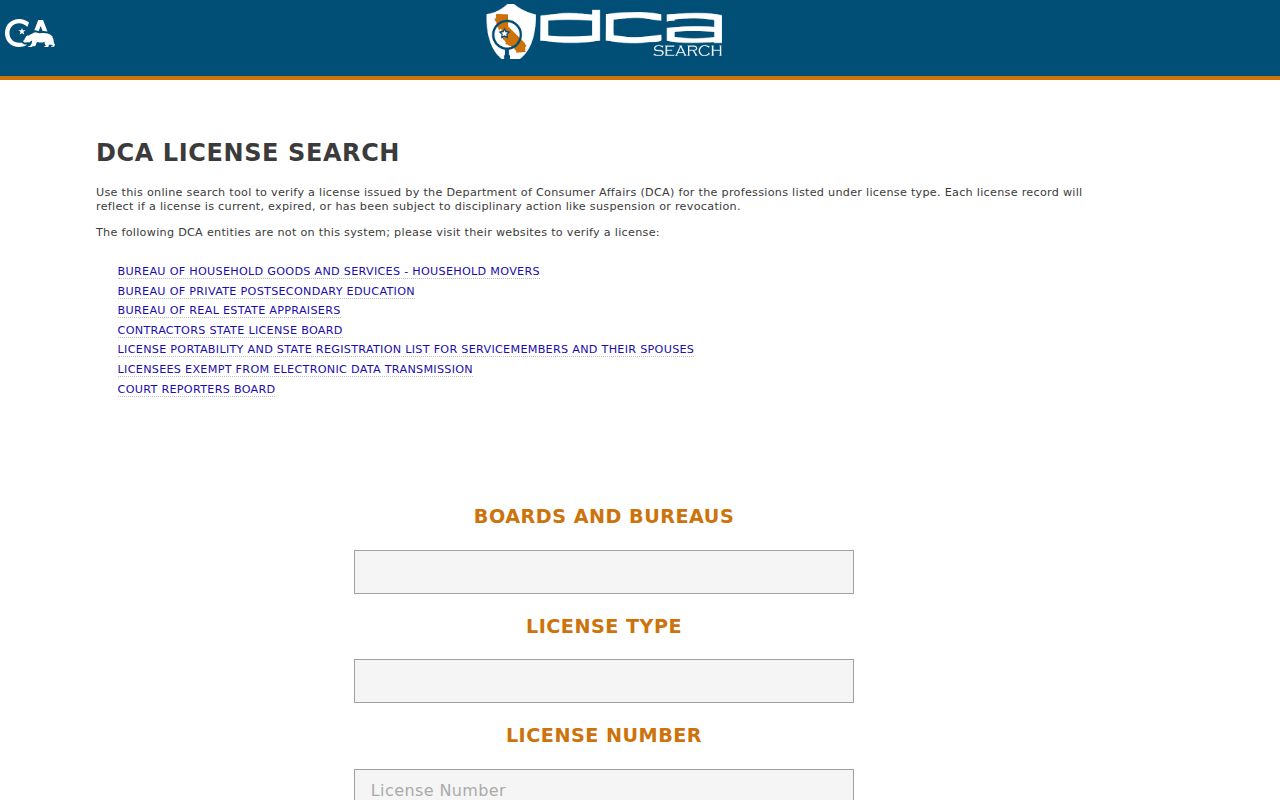
A license result can add a status or discipline clue. It cannot, by itself, prove that a licensee lives in Monrovia.
The California Secretary of State bizfile search is the better route for an entity name or number. Its basic result and filing history can connect a person to a business without turning an affiliation record into a residential claim.
That distinction protects the accuracy of a Monrovia residents directory: a business record helps identify the right person, while the parcel and deed sources answer property questions.
Monrovia Court Name Searches
Los Angeles Superior Court is the local trial-court system for Monrovia. Its civil, family, probate, and small-claims party index is not a free general resident roll. Unlimited civil, probate, and family coverage begins in 1983, limited civil in 1991, and small claims in 1992. A paid name search can still be useful for a same-name problem or an estate trail.
The court’s Case Access route is free when the case number is known. A case result can show the case number, type, filing date and location, caption, party roles, status, hearings, docket events, and available document links. Web information is not the official record. Public terminals at a courthouse can show electronic material without the per-search web charge, while certified copies come from the clerk.
The Los Angeles Superior Court case access page is the place to choose the proper route. A party-name result can point to a filing location and document count. Federal matters are separate and belong in PACER for the Central District of California.

Use a court entry to verify a party and date, then seek the clerk-held record when the detail matters. A case listing does not show every person at a Monrovia address.
California Custody Records
Custody and offender registries are specialized public systems, not resident directories. The Los Angeles County Sheriff’s Inmate Information Center can show booking or custody fields that change quickly. The California Department of Corrections and Rehabilitation CIRIS search covers state custody. The Monrovia Police Records Bureau handles eligible local reports and letters. The California Megan’s Law site has a statutory public-safety purpose and use warning. An arrest or custody record does not prove current residence or a conviction.
Open the Los Angeles County inmate information search when a county custody question is the actual question. Its returned fields may include booking, facility, status, bail, or court clues, subject to the system’s limits.
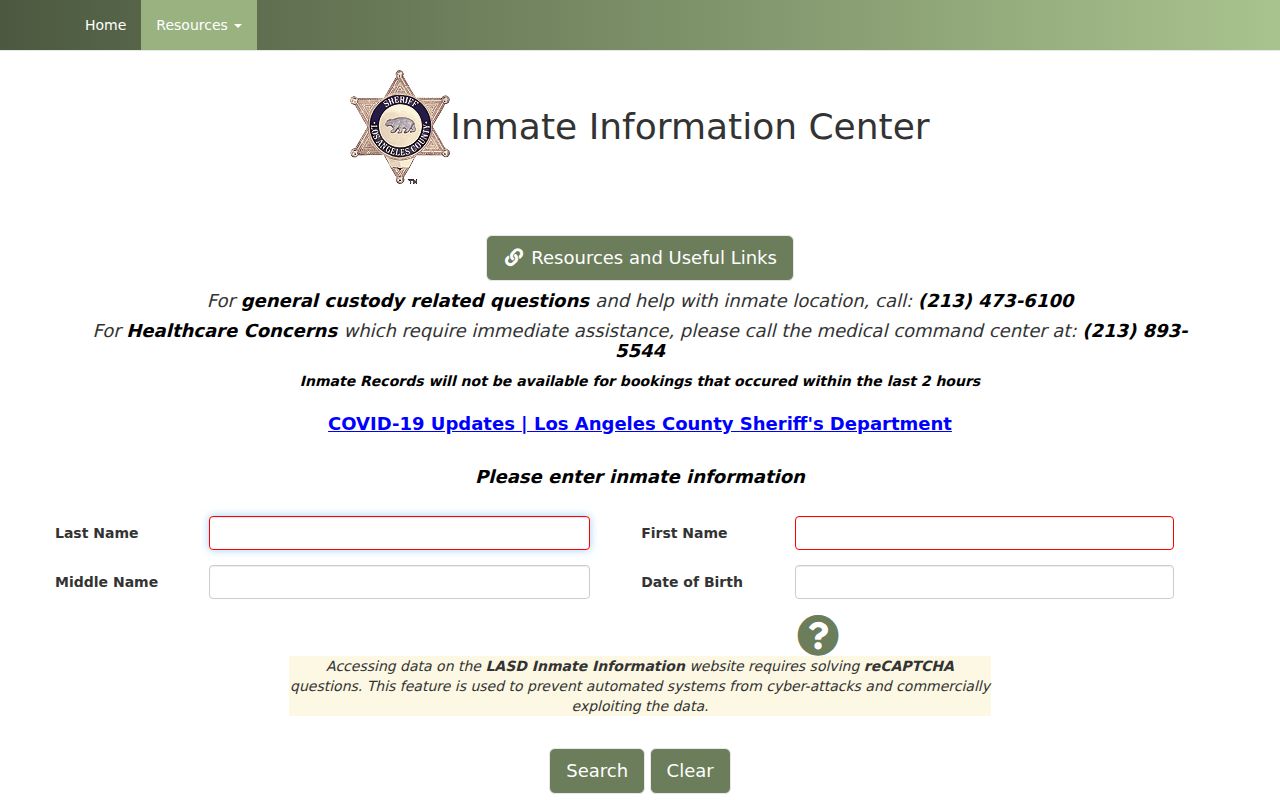
Because custody changes, a case number or court result is the stronger follow-up for an outcome. Do not use a registry to infer who belongs in a neighborhood.
The California Megan’s Law registry supplies only the fields the public system permits. Its purpose and exclusions matter, and the record should not be republished as a block list.
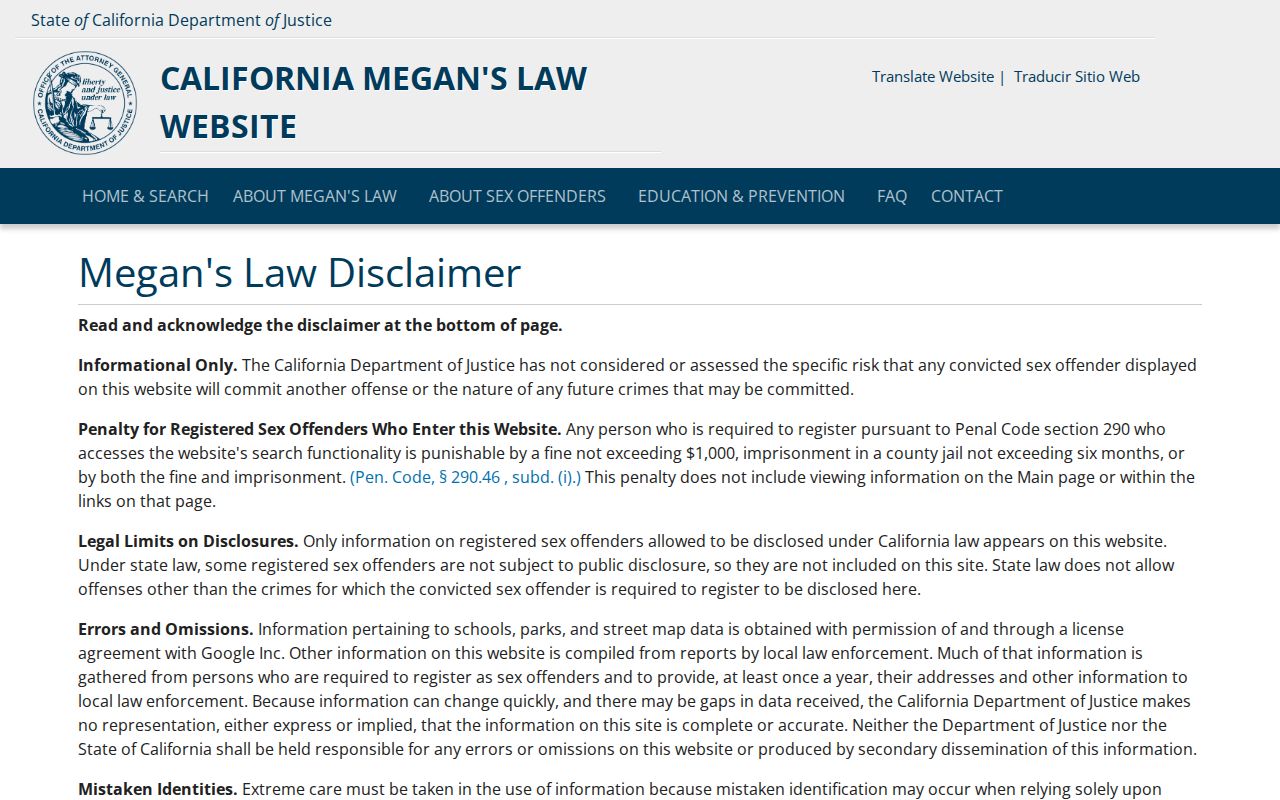
The registry image is a reminder that public availability does not erase lawful-use limits or the need to verify a record with its custodian.
Monrovia's Historical Directories
The historical residents directory begins with a shelf, not a current online roll. Monrovia Public Library’s Heritage Room holds city directories with gaps from 1908 through 1971, a Street Address Index, house-history clipping files, local histories, newspapers, and architectural books. Requests are appointment-only, and many items are for use inside the library with staff retrieval and identification.
PastPerfect adds selected directories, telephone books, house histories, biographies, yearbooks, and digitized photographs. The Historical Museum’s Trentalange Research Center reports more than 9,000 searchable directory records for 1888-1917, with selected streets in other years. The full collections and how to read an entry belong in the Monrovia city directories collection page, while the home search only needs the handoff: use an address index or reverse directory, record the occupant exactly, and test the surrounding years.
Monrovia’s local newspaper chain runs from the *Planet* in 1886 through the *News Post* in 1992, with several title changes between them. That matters because one title search can miss a move, obituary, business notice, or social item printed under another name.
Legacy's Monrovia Records
The Monrovia Legacy Project gives the historical residents directory a searchable digital layer. A March 2025 city update reported nearly 10,000 photographs and documents online, with 2,500 more planned for that summer. An August update added family collections, historic telephone directories, and high-school yearbooks. Catalog coverage grows, but an item may have a description without a downloadable image.
Search terms can be combined with AND. Controlled vocabularies such as People, Search Terms, and Subjects help when OCR or spelling variation defeats a free-text query. Exact street terms, named houses, Encinitas, Mills View, and Sawpit Canyon can open a path that a surname alone misses. A result’s title, description, record type, creator, and image availability should be copied into research notes.
A local record can also carry a story about the land. The city documents an 1887 house moved from Wild Rose and Jasmine to 323 Heliotrope. The old address and the present parcel must be kept as separate clues, then joined with permits, legal description, and directory sequence.
Monrovia Unclaimed Property Clues
The State Controller’s unclaimed-property search can surface an older name, reported city, address, holder, and property ID. It is a lead for a person or family connection, not proof of current residence. Reported addresses can be old, and a claim requires separate proof. Search spelling variants and retain the date of the result.
Use the California unclaimed-property search directly rather than paying an unsolicited finder. The official result is most useful when its name, city, and historical address line up with a directory, obituary, deed, or probate record.
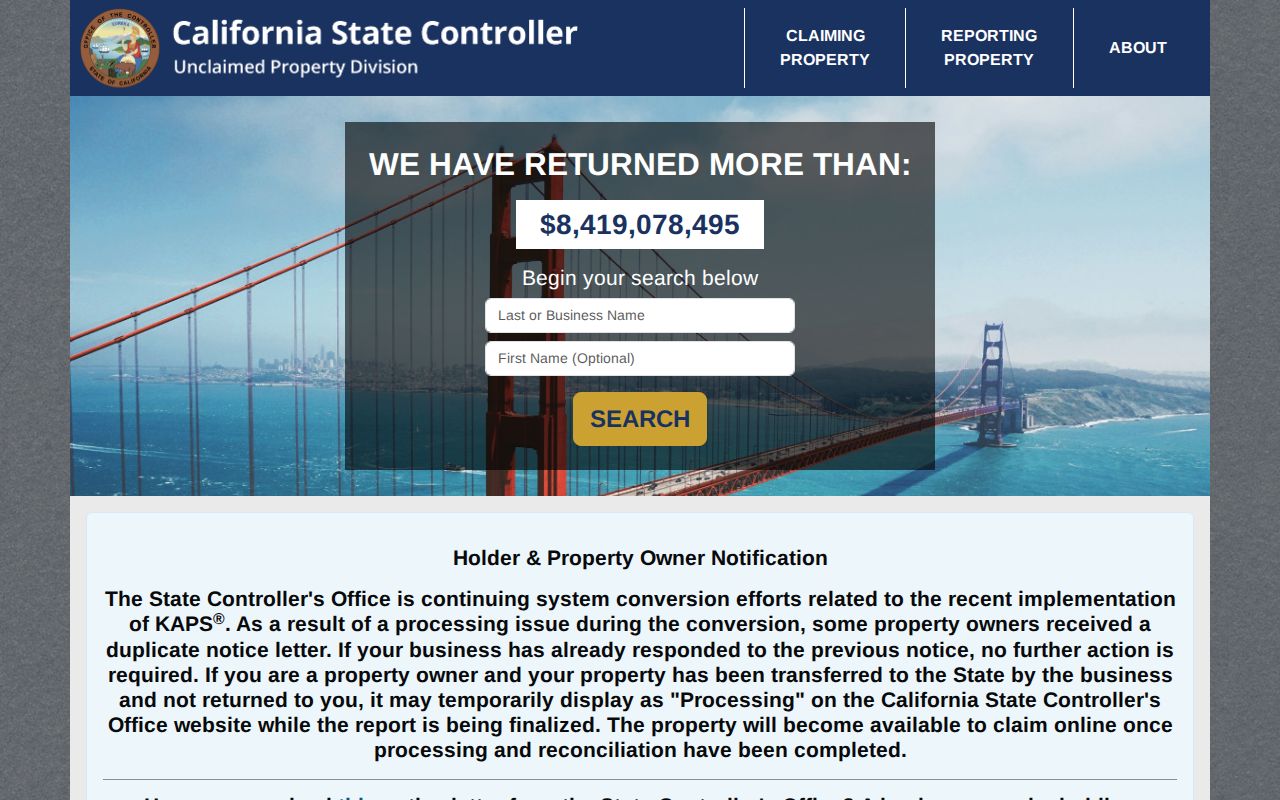
The result can narrow a family-history search. It cannot convert a stale address into a current household claim.
Monrovia CPRA Request Route
When a city record is not in OnBase, use a California Public Records Act request for an identifiable existing record. The request should name the office, record series, date range, address, incident number, or other facts that let staff locate the record. It should not ask the city to create a new answer from scattered files.
Monrovia says the City Clerk can help at City Hall, and the normal determination period is ten days under Government Code §7922.535, with a written extension of up to fourteen days for unusual circumstances. Inspection is ordinarily free. Copy charges are limited to direct duplication costs unless another law controls. City Hall is at 415 S. Ivy Avenue; the published public-record contact is (626) 932-5550 and cityclerk@monroviaca.gov. The Monrovia public-record request page is the current starting point.
OnBase may hold building-permit history and planning approvals. The Permit Book covers 1911-1947, while newer permit material is described as 1948-present in the 2026 library guide. Those records can add applicant, contractor, scope, issue date, valuation, inspection, and final-status clues to an address trail. They still do not prove continuous occupancy.
Monrovia Name-Matching Traps
Monrovia’s 2025 population estimate is 38,264 across 13.6 square miles. Compact geography does not remove same-name risk. Old Town commercial records, early residential tracts, Craftsman blocks, postwar homes, and later industrial areas generated different record patterns. A name needs a date, middle initial, spouse, parcel, occupation, or affiliation before it becomes a person.
Use two independent links. A middle initial paired with a legal description is stronger than a name alone. A spouse paired with the same directory address can support a historical match. An entity number paired with a filing address can separate business namesakes. Dates must be possible. A tax owner, deed party, court party, licensee, or directory occupant should never be silently treated as the same role.
Monrovia’s naming history also calls for care with compound surnames, married-name changes, initials, multilingual formats, and newspaper title changes. Preserve the spelling printed by the source, then record the normalized form separately. A missing result may reflect a gap, a variant, or a protected record rather than absence.
| Search path | Best use | Limit |
|---|---|---|
| Assessor and Recorder | Parcel identity, assessed ownership, title parties, legal description | Not a complete occupant or household list |
| Library, Legacy, and newspapers | Dated occupants, spouses, occupations, moves, and family clues | Gaps, old labels, and catalog or image limits |
| Commercial compilation tools | Possible lead for a spelling or address variant | Mixed sources, lag, merged names, and unclear provenance |
Lawful personal use. Monrovia records are useful for family history, civic research, reconnecting, property curiosity, and safety awareness. Do not use a lookup to stalk, harass, threaten, or intimidate a person, and verify important facts with the custodian office.
The Los Angeles County Assessor Portal remains the cleanest first check for a known address. The image below shows why saving the parcel key matters before a search moves to deeds, permits, or historical volumes.
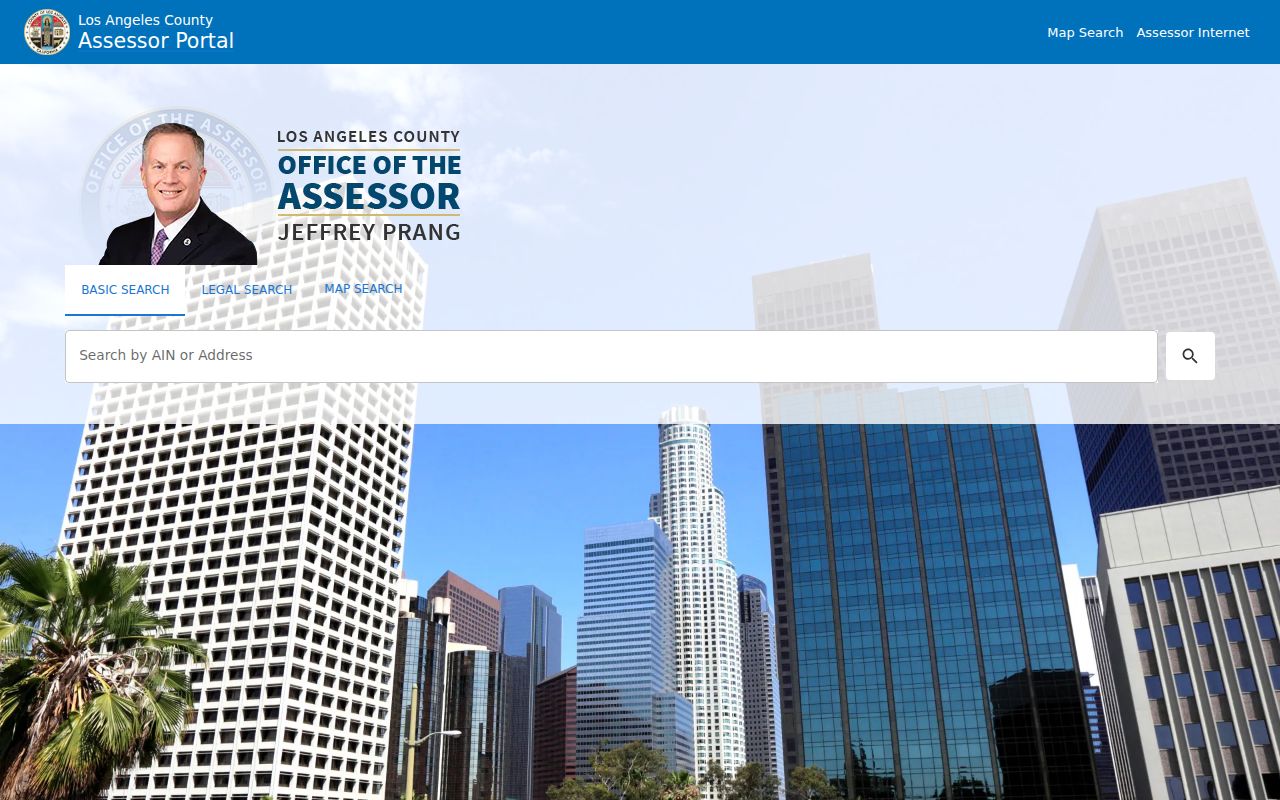
A parcel key creates a research spine. It does not turn a land record into a list of every person who lives there.
The residents directory is strongest when each result says what it proves, which custodian holds it, and what remains unknown.